What to Look For Before You Even Ask Questions
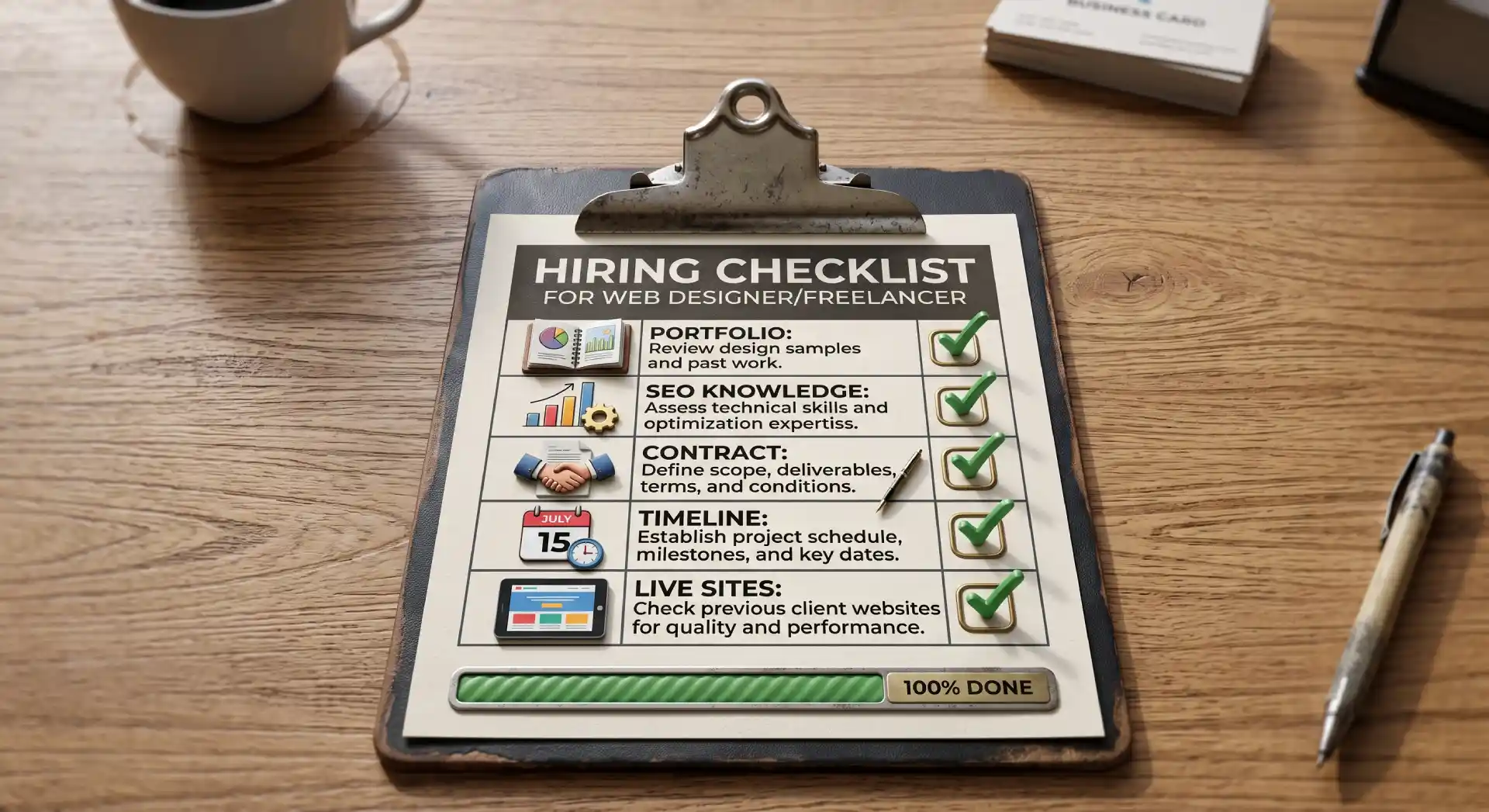
Before you send that first email, look for three things:
A portfolio of live sites, not screenshots. Anyone can take a screenshot of a pretty homepage. A live site tells you whether it loads fast, works on mobile, and ranks for anything. Click through. Test the contact form. Search the business name on Google and see if the site shows up.
Evidence they understand SEO. Search the designer’s own business name. If they don’t rank for their own name or their own services, they don’t know SEO : and your site won’t either. A web designer who says “I don’t do SEO” is like a car mechanic who says “I don’t do engines.” SEO is not a separate service. It’s built into the structure of the site.
Specific claims, not vague promises. “I build beautiful websites” means nothing. “Every site launches with 95+ PageSpeed scores, mobile-responsive design tested on real devices, and meta descriptions written for the keywords you actually want to rank for” means something. Look for specificity in their portfolio, their process, and their proposals.
10 Questions to Ask Before Hiring a Web Designer
1. What does your process look like from start to finish?
A real process has stages: discovery, strategy, content, design, development, testing, launch. Each stage has a deliverable and a timeline. If the answer is “I design in Figma and then build it in WordPress,” that’s not a process : that’s skipping half the work. The missing stages (strategy and content) are where sites actually succeed or fail.
A good process starts with questions about your business, your customers, and what you need the site to do. Content comes before design because you can’t design around a message that doesn’t exist yet. Testing happens on real devices, not just in a browser preview. Launch includes sitemap submission, SSL verification, and a handoff so you know how to update the site afterward.
2. Will the site be optimized for search engines?
This is the question that separates web designers from website builders. SEO needs to be built into the site from day one : not added later as an upsell.
A designer who does SEO should be able to tell you: what keywords they’d target for your business, how they structure headings and meta tags, whether they add schema markup, how they optimize images for page speed, and what they do to make sure Google can actually find and index the site. If the answer is “I install Yoast” or “that’s a separate service,” keep looking.
3. How much will it cost and what exactly is included?
A business website in the Philippines typically costs between PHP 45,000 and PHP 250,000 depending on size, complexity, and what’s included. The price should be specific and itemized. “Around PHP 50K” is a guess. “PHP 55,000 for a five-page custom WordPress site including content strategy, copywriting, SEO setup, mobile testing, and one month of post-launch support” is a proposal.
Ask what’s not included. Some designers charge separately for content writing. Some don’t include mobile testing. Some hand off the site and disappear. Know what you’re paying for before you pay.
4. What happens after the site launches?
Launch is not the finish line. Sites need updates, security patches, and occasional fixes. Ask what support looks like after launch. Is there a warranty period? What does ongoing maintenance cost? What happens if something breaks at 11 PM on a Saturday?
A designer who offers post-launch maintenance is signaling that they stand behind their work. A designer who hands off the site and stops returning emails was never planning to stick around.
5. Will the site work well on mobile phones?
This should be a yes : immediately and without qualification. In the Philippines, the majority of small business website traffic comes from phones. Your site either works on a 6-inch screen or it loses customers.
Ask how they test mobile responsiveness. “I resize my browser” is not testing. “I check every page on an actual phone before launch” is. Navigation should collapse cleanly, buttons should be sized for thumbs, forms should work with touch keyboards, and text should be readable without pinching and zooming.
6. Can you show me sites you built that are actually ranking?
A portfolio of pretty screenshots is easy. A portfolio of sites that rank on Google is evidence. Ask for specific examples: “Show me a site you built that ranks for a competitive keyword in that business’s industry.” Then search that keyword yourself and verify.
This filters out designers who build beautiful sites nobody can find. A site nobody sees is a site that doesn’t work, regardless of how good it looks.
7. Who writes the content?
Content is usually the bottleneck. The designer waits for you to send text. You don’t have text. The project stalls.
Ask whether content writing is included. If it’s not, ask what they recommend. Do they work with a copywriter, or do they expect you to provide finished text? A designer who includes content strategy and copywriting removes the biggest source of project delays.
8. How long will it take?
A five-to-seven-page business website typically takes three to four weeks from kickoff to launch. Larger or more complex projects take longer. The timeline should come with milestones : first draft, revisions, testing, launch. Not an open-ended “it depends.”
Be wary of promises that are too fast (a week) or too vague (“whenever it’s done”). Too fast means corners are cut. Too vague means there’s no plan.
9. What platform do you build on and why?
WordPress powers 43% of the web. It’s flexible, scalable, and you own it : unlike Wix or Squarespace where you’re essentially renting. A good designer should be able to explain why they chose their platform and what it means for you.
Ask specifically about ownership. Can you move the site to another host? Can another developer work on it? Do you need the designer to make every update, or can you handle basic changes yourself? If the answer involves proprietary software or a locked-in platform, that’s a red flag.
10. What questions do you have for me?
A good designer interviews you as much as you interview them. They should ask about your business, your customers, your goals, what’s working now, and what’s not. If they don’t ask any questions and jump straight to pricing, they are selling a template, not a solution. Learn more about Jude Pudlao : a freelance web designer in Baguio who answers all ten of these questions before you ask them.