
- Home >
- GrowMentrix SEO Agency Website Redesign and Development
An SEO Agency's Website Was Broken. Here's How We Fixed It
This website redesign case study from the Philippines breaks down what happens when an SEO agency’s self-built site is not working and they need someone who actually builds sites that perform. No theory. Just the rebuild, the numbers, and what changed.
- 95+ Google Speed Score
- 100/100 SEO Score
- 1.5 seconds mobile load time

The starting point: a website that was not working
GrowMentrix is a new digital marketing agency based in the Philippines. They handle SEO, web design, and content strategy for clients across five continents. Local SEO. Technical SEO. Content. Audits. The full stack.
When they came to me, they already had a website. They built it themselves. The problem was it was not working.
The site loaded in 8 seconds. Seventy-two percent of the links were broken. There was zero security hardening. No performance optimization. For an agency selling speed and visibility, their own site was the opposite of what they promised clients.
This was a website rescue job. An SEO agency website redesign where the stakes were higher than usual. The site was live. Potential clients were seeing it. Every time someone searched for their services and found a slow, broken site, GrowMentrix lost credibility they could not afford to lose.
Why it could not wait
An agency’s website is the first audit a client runs. Before they book a call, before they read a proposal, they check:
- Does it load fast? GrowMentrix’s self-built site took 8 seconds. If you sell speed and your own site crawls, the conversation ends before it starts.
- Does it show up on Google? If you sell SEO and cannot rank your own brand, what are you selling?
- Does it look like a template? Agencies that use off-the-shelf themes for themselves will use them for you.
- Is it secure? Clients share analytics access, ad accounts, and strategy documents. A breach loses more than data. Their site had no security hardening at all.
The self-built site was not just underperforming. It was actively hurting their credibility. Every day it stayed live was a day it told potential clients the wrong story. For a new agency trying to win trust in a crowded market, that kind of first impression is expensive.
The brief was simple: the site had to be the best proof of work I had.
Part 1: Build a site worth finding
Content
Every page was written fresh. The messaging hangs on a single line the client already believed in: “We do not chase vanity metrics.”
I wrote 11 pages: five service pages, About, Contact, Blog, and Projects. Each page targets specific search terms. Each answers the questions a business owner would type into Google at midnight, trying to figure out whether they need SEO or just a better website.
Design
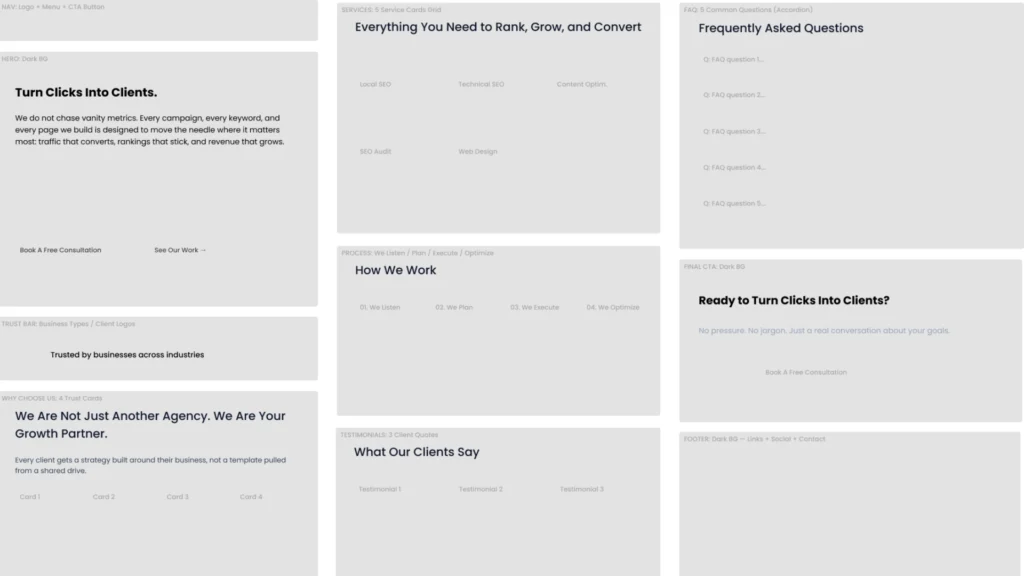
With the content locked in, I moved to Figma. Started with low-fidelity wireframes. Bare structural layouts that mapped where each content block would live and what job it was doing on the page. No colors, no fonts, just the skeleton. Content-first means the words drive the layout, not the other way around.
From there, I built the mockup through five iterations of the homepage, refining the visual direction each round. Each section answers a question a potential client actually asks:
- What do you do?
- Why should I trust you over the other 50 agencies in my inbox?
- How do you work?
- What results have you gotten for people like me?
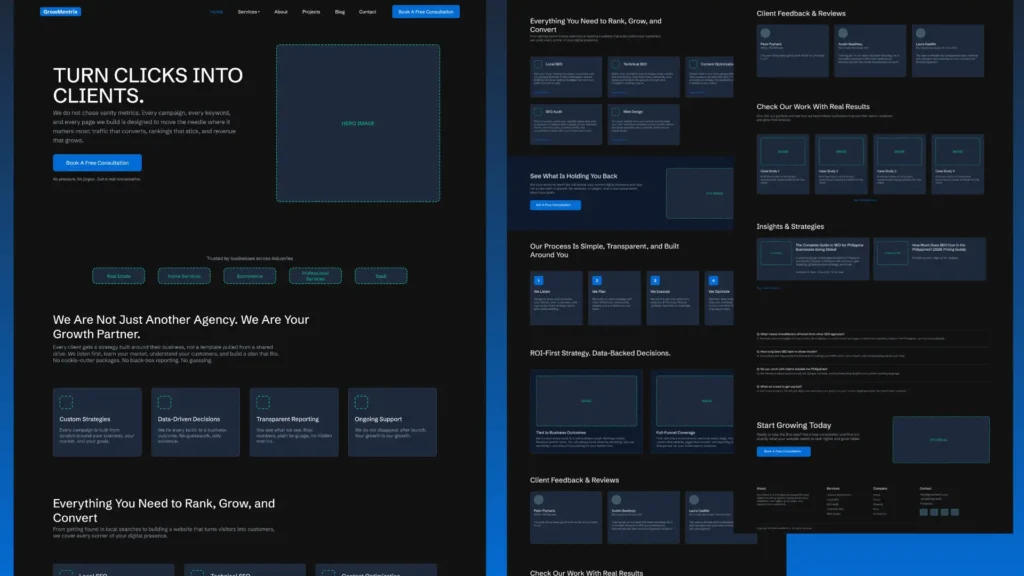
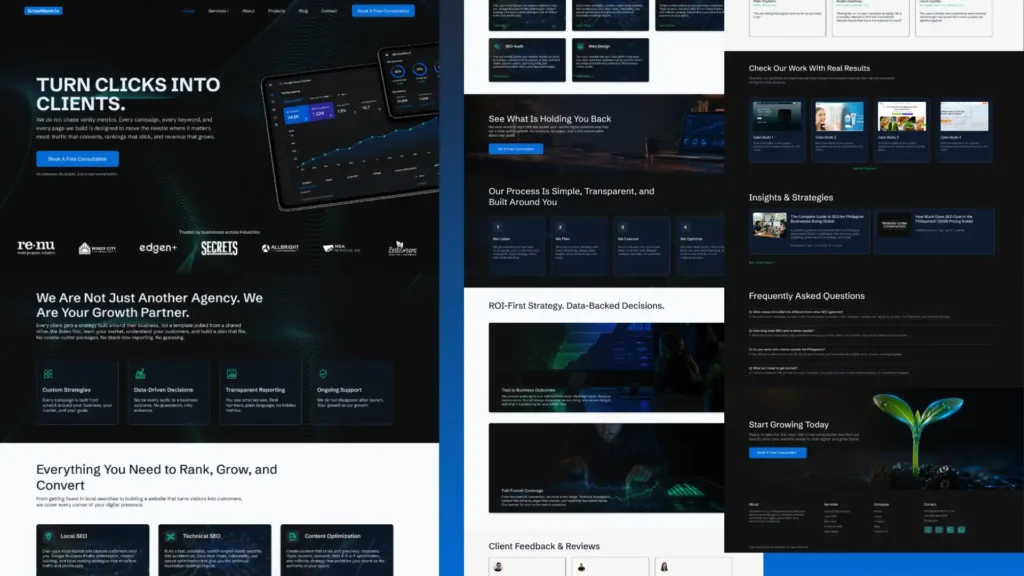
The visual direction alternates between dark and light sections. Dark sections use high-contrast typography on deep backgrounds. Light sections open up with clean white space. Two fonts. No animation for the sake of animation. The design gets out of the way and lets the message and the numbers do the talking.
Development
With the mockup finalized, I built the site in Elementor section by section. As each one came together, I adjusted the design. Spacing, sizing, how elements sat next to each other in a real browser. Things that looked right in Figma sometimes felt off once they were live. A heading that balanced perfectly against a paragraph in the mockup might need more breathing room on a phone screen. A button alignment that made sense in isolation could look awkward when stacked with the section above it.
No mockup survives the build unchanged. That is not a failure of planning. It is the difference between a static canvas and a living page. The browser is where it counts.
The 11-page website build timeline for this Philippines-based project ran from wireframes to launch in a few weeks. Content, design, development, and SEO happened in parallel. Every section was tested against real browser behavior before the next one started.
Part 2: Make it impossible to ignore
Speed
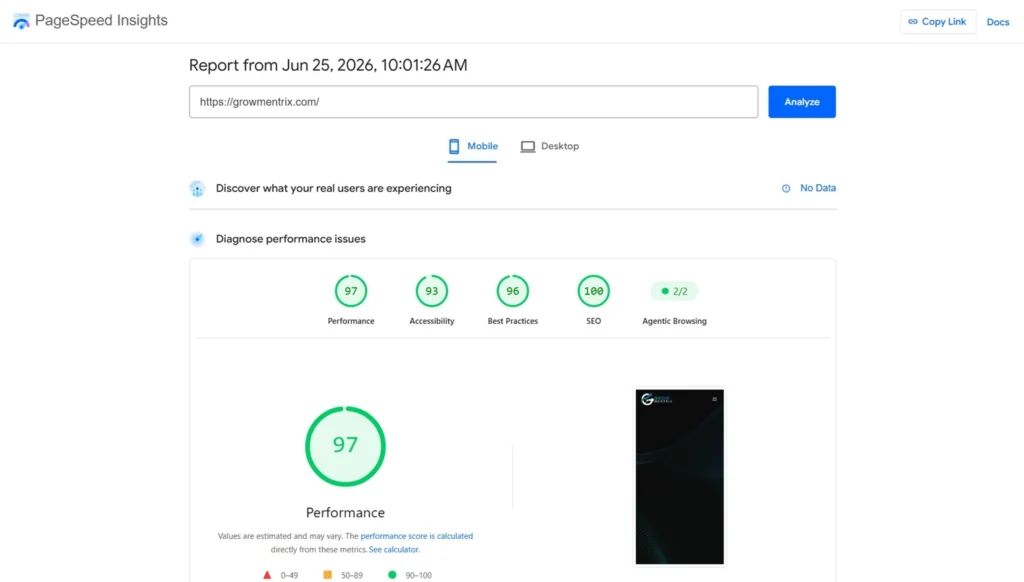
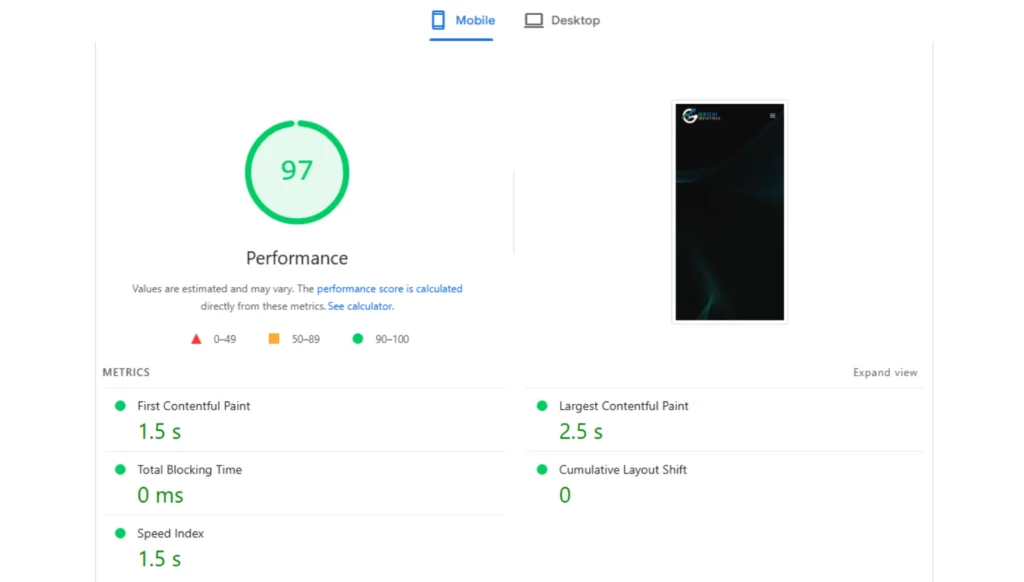
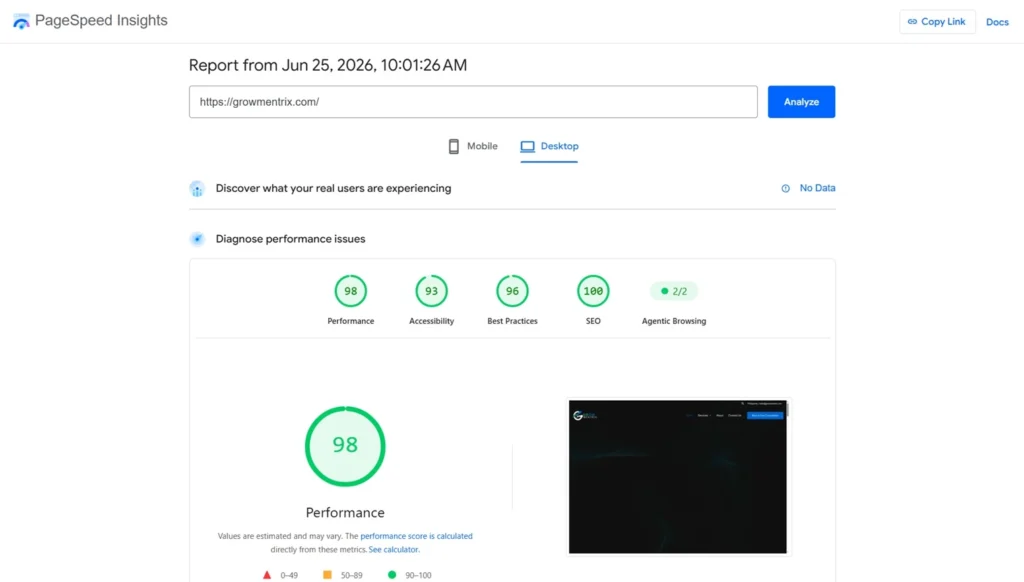
Most websites built with page builders score between 40 and 60 on Google’s mobile speed test. GrowMentrix scores 95 to 99.
The WordPress website speed optimization results came from a handful of deliberate decisions, not a stack of caching plugins. Fonts are hosted on the server instead of pulled from Google. Fewer network requests, faster rendering. Unused code is stripped so browsers only download what the page actually needs. Images are served in modern formats and only loaded when someone scrolls to them.
The outcome is a WordPress site without page builder bloat hitting 95+ speed. No themes stuffed with features nobody asked for. No plugin spaghetti. Just clean architecture and page speed optimization treated as a core feature, not an afterthought.
1.5 seconds to load on mobile. Before optimization, that number was 8 seconds.
SEO
On Google’s own SEO checklist, the site scored 100 on both mobile and desktop. Every page has a unique title and description. The URL structure is logical and clean. The sitemap was submitted to Google on launch day.
These custom WordPress website results come from building SEO into the architecture, not bolting it on after launch. If someone searches for what GrowMentrix offers, the site is built to show up.
Security
I ran the site through an independent security scanner. It passed 9 out of 10 checks: HTTPS enforcement, clickjacking protection, MIME-type verification, referrer policy, permissions restrictions, and cross-origin isolation.
The one gap is the content security policy. The hosting provider enforces a baseline that cannot be overridden at the server level. Adding a CDN layer would close this and push the grade from C+ to A+. This is noted, documented, and on the roadmap.
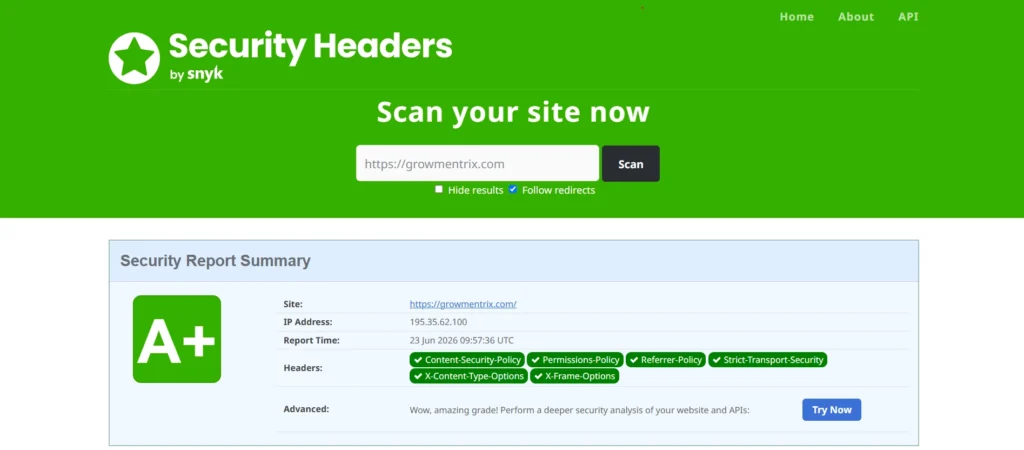
Table of Contents
Key Metrics
- 95+ Google speed score (mobile)
- 100/100 Google SEO score
- 1.5s mobile load time
- 9/10 security checks passed
Services Provided
- Custom WordPress Website Design
- Page Speed Optimization
- Website Copywriting
- Web Maintenance & Hosting
The Results
Every web design project with metrics tells two stories: the starting numbers and the shipped numbers. This WordPress website went from 0 to a 95+ PageSpeed score.
The initial staging build had issues: 8-second load times, broken links everywhere, zero security hardening. Here is what shipped:
| What | Before | Launched |
|---|---|---|
| Website | Live, but slow & broken | 11 pages, redesigned |
| Google speed score (mobile) | -- | 97 / 100 |
| Google SEO score | -- | 100 / 100 |
| Mobile load time | 8.0 seconds | 1.5 seconds |
| Broken links | 72% of links | 0 |
| Security checks passed | 0 | 9 of 10 |
| Page jumps around while loading? | -- | Zero movement |
GrowMentrix now has a site that backs up every claim they make. It loads fast. It ranks. It is secure. It looks custom because it is.
Every prospective client who runs a speed test or checks their search presence is auditing GrowMentrix before they reach out. The site does the selling before the first call happens.
This was not a one-off.
I rank my own website on the first page of Google for competitive terms like “web design Philippines.” GrowMentrix got the same playbook I use on every custom WordPress website design project: clean architecture, content built for search intent, and a performance budget that treats every millisecond as a conversion risk.
If your site is slow, invisible, or looks like everyone else’s, the fix is not more plugins or another template. It is a rebuild with search and speed as the foundation, not afterthoughts.
Want this for your business?
Same playbook, built for your market. Every project starts with a 15-minute discovery call. No obligation. No sales pitch. Just a conversation about where your site is now and where it could be.
Frequently Asked Questions
How to get a 95+ Google PageSpeed score on WordPress
Most WordPress sites are slow because of too many plugins, bloated themes, and unoptimized images. The fix is not another caching plugin. It is discipline. Host fonts locally. Strip unused CSS. Serve images in WebP format. Defer JavaScript that does not need to run immediately. These are not secrets. They are just rarely done because they take time.
How long does a full website redesign take?
GrowMentrix went from zero to launch in a few weeks. The timeline depends on how many pages, how much custom design, and how quickly content decisions get made. A focused 5 to 10 page site with clean design and proper SEO can launch in 2 to 4 weeks if feedback is fast.
Why does an agency's own website matter so much?
Because clients check. Before they book a call, they run your URL through a speed test. They search your brand on Google. They look at your design and decide in three seconds whether you are the real thing. Your website is your first, loudest, and most honest salesperson.
Can you get the same results for my business?
The playbook is the same. Clean architecture. Content built around what your customers actually search for. Performance treated as a feature, not an afterthought. The specifics change. Your market, your keywords, your design. But the principles do not.
Let's work together.
Web design, SEO, and content handled by one person who knows how all three fit together. Based in Baguio City, working worldwide.