What Is Generative Engine Optimization (GEO)?
AI search engines work differently from Google. Google crawls, indexes, and ranks pages based on hundreds of signals: backlinks, content quality, page speed, and more. AI search engines like ChatGPT, Perplexity, and Google AI Overviews don’t rank pages. They generate answers.
When someone asks ChatGPT, “what is the best web hosting for a small business in the Philippines“, ChatGPT doesn’t search the web in real time the way Google does. It generates an answer based on its training data and, increasingly, on real-time web browsing and retrieval-augmented generation (RAG). In both cases, the AI has to choose which sources to cite. That choice is what GEO optimizes for.
GEO is the practice of structuring your content so AI engines can find it, understand it, and cite it. It covers:
- Technical accessibility. Letting AI crawlers access your site
- Content formatting. Making your content easy to extract and quote, and
- Authority signals. Convincing AI models that your content is trustworthy enough to cite.
If your site already has SEO that is built in from day one, GEO is the next layer on top.
Think of it this way, SEO gets you found by humans typing into Google. GEO gets you found by AI answering those humans’ questions. They’re not competing, they’re stacking.
How AI Search Engines Choose Which Websites to Cite
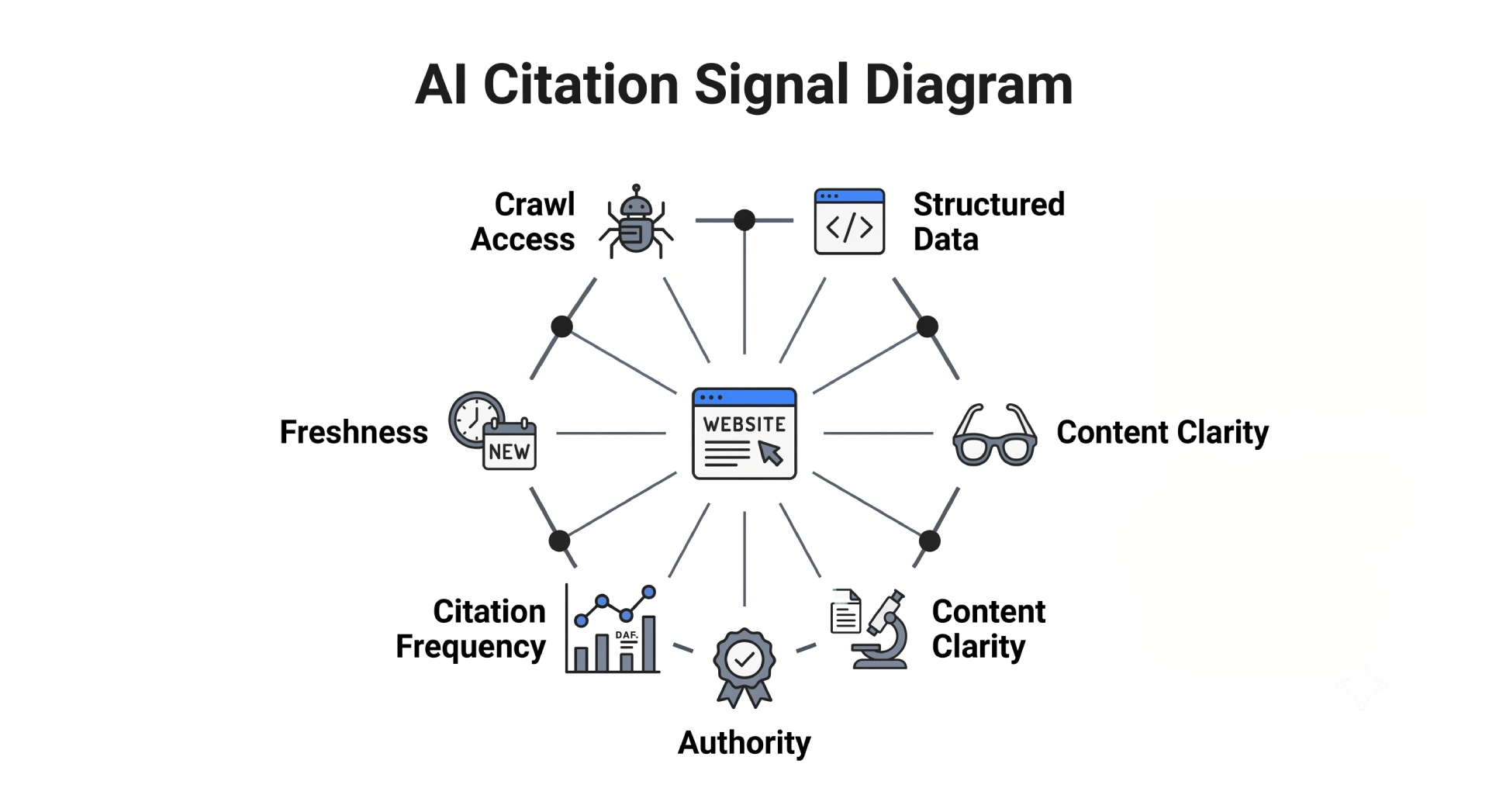
AI models don’t have opinions about which websites are “best.” They use signals:
The AI doesn’t “rank” you, it decides whether to quote you. And that decision happens in milliseconds, based on whether your content is accessible, structured, and authoritative enough to trust.
4 Steps to Optimize Your Content for AI Citation
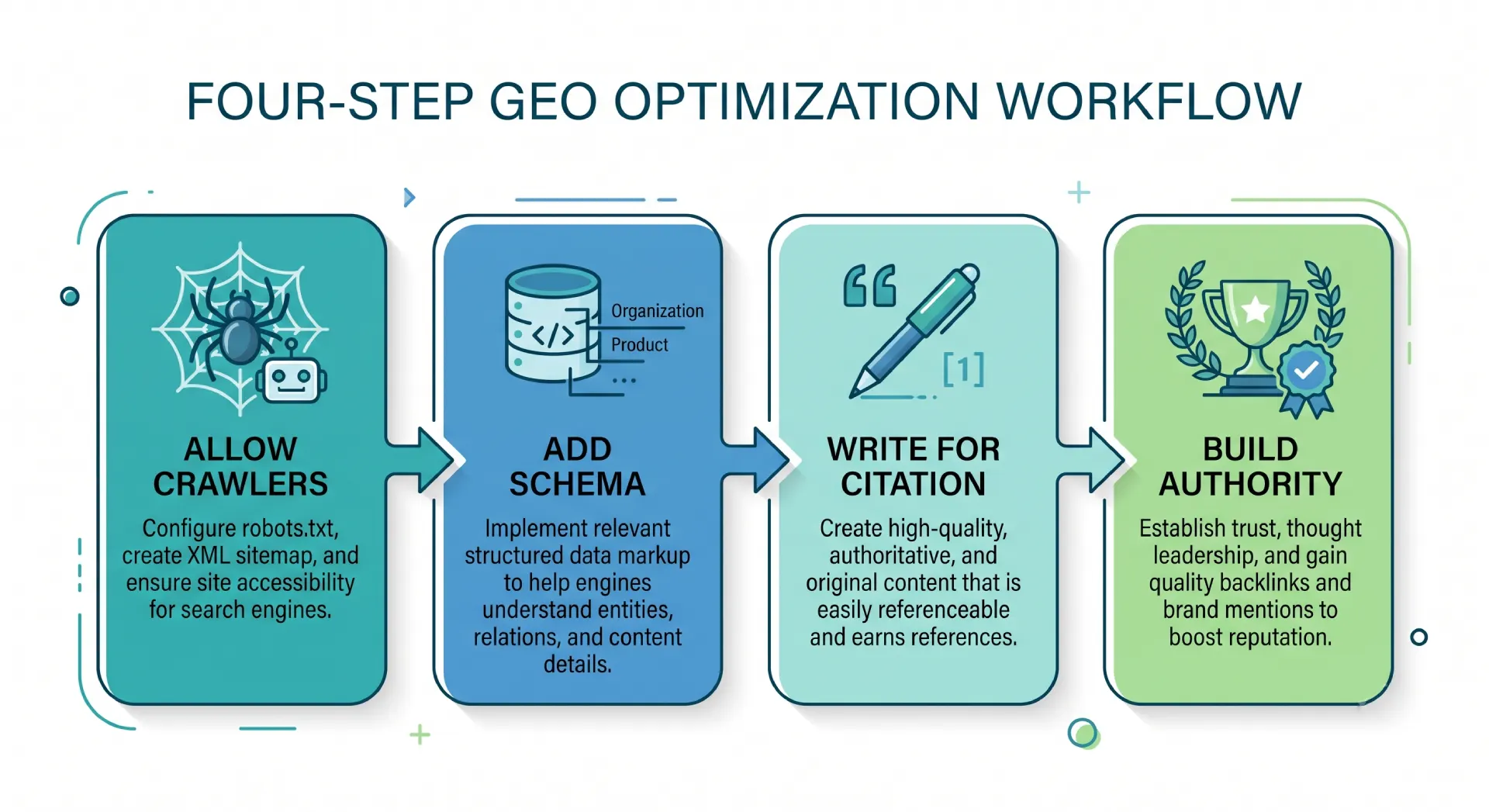
1. Let the AI Crawlers In
Most AI crawlers are blocked by default. Googlebot has decades of established norms. GPTBot and Claude-Web don’t : many sites block them out of caution, not strategy.
Open your `robots.txt` file and add:
User-agent: GPTBot
Allow: /

User-agent: ChatGPT-User
Allow: /

User-agent: Claude-Web
Allow: /

User-agent: PerplexityBot
Allow: /

User-agent: Google-Extended
Allow: /
This tells every major AI crawler that you’re welcome here. Blocking them means your content cannot be cited, period. It doesn’t matter how good your content is if the AI can’t reach it.
2. Use Structured Data
Structured data, JSON-LD schema markup, is the single most important technical factor for AI citation. It gives AI engines machine-readable descriptions of your content. Instead of parsing paragraphs of text, the AI reads structured question-answer pairs, article metadata, and entity relationships.
The schema types that matter most for AI citation:
- FAQPage: Q&A pairs that AI engines can quote directly. If your page has a FAQ section, wrap it in FAQPage schema.
- Article: Headline, author, date, description. Helps AI attribute citations correctly.
- Organization/Person: Who you are, where you’re based, what you do. Feeds entity understanding.
- BreadcrumbList: How pages relate to each other. Helps AI understand site structure.
A page with FAQPage schema is dramatically more likely to be cited by AI engines than a page with the same Q&A content in plain paragraphs. The schema makes the content extractable.
3. Write for Citation, Not Just Ranking
AI engines quote content differently than Google ranks it. Google evaluates the whole page. AI engines extract specific passages. Your content needs to be quotable.
Answer-first format: Put the direct answer in the first 50-100 words of each section. Don’t build up to it but lead with it. AI engines pull answers from the top of the content, not the middle.
Standalone paragraphs: Each H2 section should contain at least one paragraph that makes complete sense when quoted out of context. No “as we discussed above” or “see the next section.” Every section stands alone.
Specificity over generality: “A typical WordPress maintenance plan costs between PHP 3,000 and PHP 8,000 per month in the Philippines, depending on what’s included” will be quoted. “Website maintenance costs vary widely depending on your needs” will not.
Source your claims: Link to original data, cite specific studies, reference real examples. AI models weight verifiable claims higher than unsourced assertions.
4. Build Authority That AI Models Recognize
AI models don’t have a Domain Rating score. They evaluate authority through different signals:
- Citation frequency: How often other trusted sources reference your content
- Entity consistency: Do multiple sources describe you the same way? Is your Person schema consistent with your LinkedIn profile?
- First-hand experience: Does the content describe things the author actually did, or is it generic advice anyone could write?
- Publication history: Has the author been publishing on this topic consistently, or is this a one-off?
The E-E-A-T framework (Experience, Expertise, Authoritativeness, Trustworthiness) maps directly to AI citation. An article about web design by someone who has designed 50+ websites will be cited over an article on the same topic by a generic content site. First-hand experience is the hardest signal for AI-generated content to fake.
Structured Data: The Single Most Important AI Visibility Factor
If you do one thing for AI visibility after today, add FAQPage schema to every page with Q&A content.
FAQPage schema wraps your questions and answers in JSON-LD markup that AI engines can parse directly. It transforms this:
Q: How much does WordPress maintenance cost?
A: Plans typically range from PHP 3,000 to PHP 8,000 per month…
Into machine-readable structured data that ChatGPT, Perplexity, and Google AI Overviews can extract and quote verbatim. The content is the same. The difference is whether the AI can find it.
FAQPage schema is not a Google ranking factor. Google retired FAQ rich results in May 2026. But it is the strongest AI citation signal available. AI engines use it to identify quotable Q&A content. Pages with FAQPage schema get cited. Pages without it get skipped.