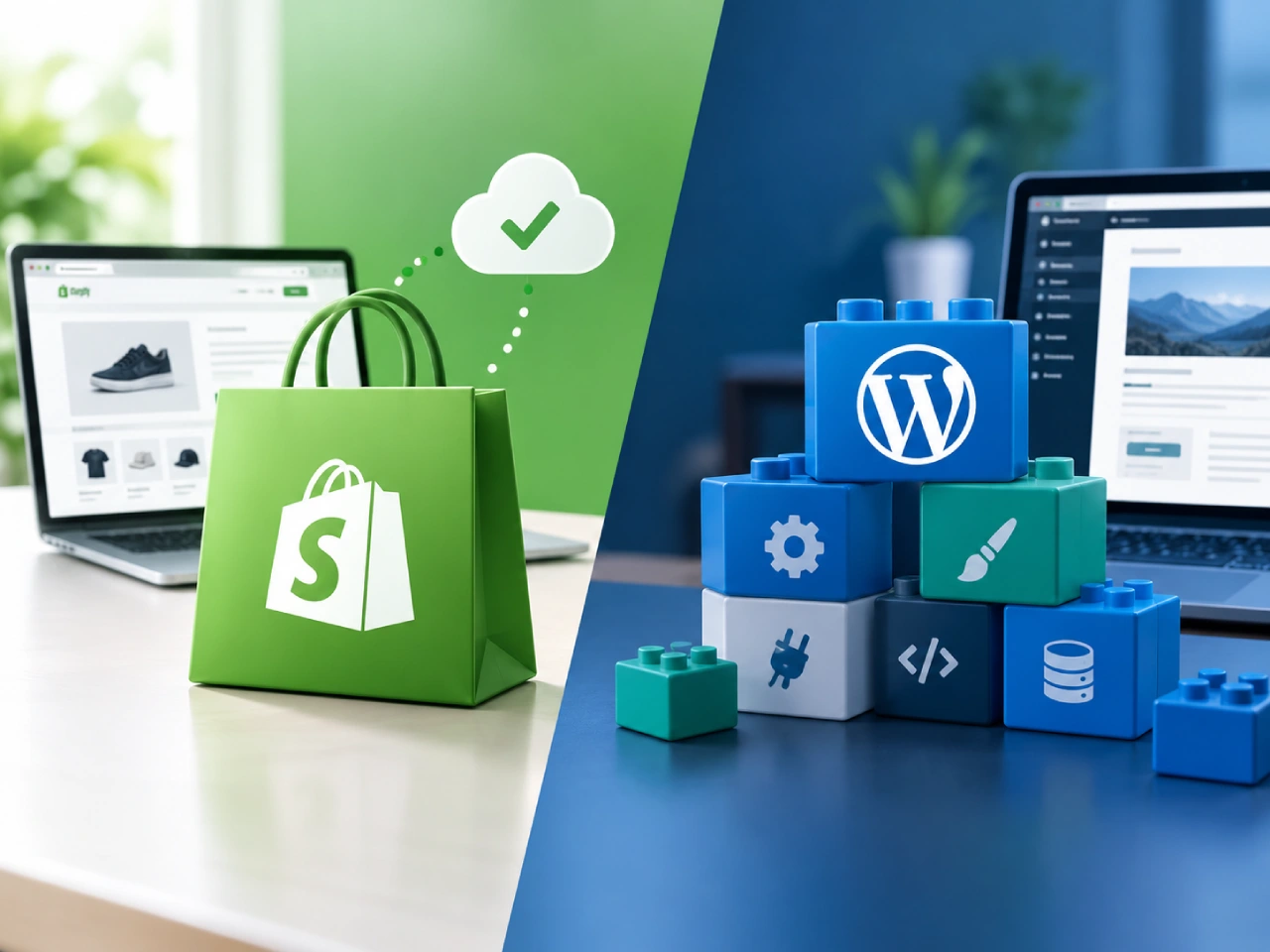
“Should I build my store on Shopify or WordPress?” This is the first question almost every seller asks me, and the honest answer is that neither one is better. They are better at different things. Shopify gets you selling in days with almost no setup. WordPress, with WooCommerce, gives you full ownership and room to grow without a platform fee on your sales. The platform that fits you depends on what you sell, how much control you want, and how long you plan to stay in business.
Shopify is a hosted platform: fast to launch, but you rent it and pay a monthly subscription, plus a per-order fee if you use a payment provider other than Shopify Payments. WordPress with WooCommerce is self-hosted: more setup, but WooCommerce takes no cut of your sales, while hosting, paid extensions and payment processing still cost money. Choose Shopify for speed and simplicity, WordPress for ownership and long-term flexibility. WordPress runs about 40 percent of all websites (W3Techs, 2026-10-19).
Key Takeaways
- Shopify is hosted, so it is the fastest way to launch a store with zero technical work.
- WordPress with WooCommerce is self-hosted, so you own your store, your data, and your costs.
- Shopify charges a monthly subscription, and adds a fee on each order if you use an outside payment provider. WordPress with WooCommerce takes no cut of sales, but you pay for hosting, paid extensions and payment processing.
- Shopify is closed and rigid. WordPress is open and can be shaped into almost anything.
- The decision is speed versus control: pick based on your product catalog and your growth plan.

What Each Platform Is Built For
Shopify was built to do one thing well: take a product, put it in a cart, and check out. It handles the hosting, the security, the payment processing, and the updates for you. You sign up, pick a theme, add products, and you are live. That convenience is real, and it is why Shopify is the default choice for sellers who want to launch this week and do not have a developer on call.
WordPress is a different animal. It runs about 40 percent of all websites (W3Techs, 2026-10-19). It is a general-purpose platform, and WooCommerce turns it into a store. That means more moving parts to set up, but also no ceiling on what you can build. You control the hosting, the design, the payment gateways, the shipping rules, and every plugin. For a store that wants custom product configurators, subscription models, or tight control over SEO and design, WordPress is where that freedom lives.
The Real Cost of Ownership
Shopify’s cost is easy to see and easy to underestimate. You pay a monthly subscription, and if you use a payment provider other than Shopify Payments, Shopify adds a fee on each order. That fee is lower on higher plans, and Shopify says it charges no setup fees on any plan (Shopify pricing page, checked 2026-10-20). Card processing fees depend on the plan too. Add paid apps for features you assumed were included, and the bill grows as the store does.
WordPress with WooCommerce works differently. WooCommerce says it has no platform fees and no revenue share, and that your only per-sale cost is your payment solution’s processing fees (WooCommerce pricing). But “no cut of your sales” does not mean free. You still pay for hosting, your domain, any paid extensions, and payment processing. You are also responsible for updates, backups and security, or you pay someone like me to handle them. Whether that adds up to less than Shopify depends on your sales volume, your extensions and your hosting, so price both with your own numbers before you decide.
Flexibility Versus Speed to Launch
This is the core trade, and it is the one to stare at honestly.
Shopify is fast but rigid. You can change a theme, but you cannot easily bend the checkout, the URL structure, or the content model beyond what Shopify allows. When your store outgrows the template, you either buy more apps or fight the platform.
WordPress is slower to set up but has no ceiling. You can build any design, any checkout flow, any integration. You own the code and the data. If you want to move hosts, change developers, or redesign everything, nothing is locked in.
Who Should Pick Which
Pick Shopify if you are launching a standard product store quickly, you want the platform to handle the technical side, and you are comfortable paying for that convenience as you grow.
Pick WordPress if you sell products that need custom options, you care about owning your store and your data, you want to keep platform fees off every sale, or you already know you will be in business for years.
The decision in one table:

| Consideration | Shopify | WordPress + WooCommerce |
|---|---|---|
| Time to launch | Days | A week or two with setup |
| Ownership | Rented, closed | Owned, open source |
| Costs | Subscription, plus a per-order fee with outside payment providers | Hosting, paid extensions and payment processing; no platform fee or revenue share |
| Flexibility | Limited to the platform | Unlimited |
| Best for | Quick, standard stores | Growing, custom stores |
Build It on the Right Foundation
Whichever you choose, the goal is the same: a store you control enough to grow into. My web design services cover both, so you are not forced into one platform by a vendor who only knows the other. If you are leaning WordPress, my guide to publishing a WordPress website walks through what setup actually involves, and my look at managed WordPress hosting explains how to get Shopify’s hands-off convenience on a platform you own.Table of Contents
About the Author
Jude Pudlao is a freelance web designer and SEO specialist based in Baguio City, Philippines. He builds WordPress websites for small businesses that need to get found on Google and convert visitors into customers.
His work combines design, development, and search optimization so his clients get websites that look professional and actually perform.
Let's work together.
Over 6 years of experience. Results you can measure. Websites that do the selling for you.
Frequently Asked Questions
Is Shopify easier than WordPress?
Yes, for a standard product store. Shopify handles hosting, security, and payments so you can launch in days. WordPress gives you more control but asks you to set up and maintain more, or pay someone to.
Which is cheaper in the long run?
It depends on your volume and setup, so compare both with your own numbers. Shopify charges a subscription and a per-order fee when you use an outside payment provider. WooCommerce on WordPress takes no platform fee or revenue share, but you still pay for hosting, paid extensions and payment processing.
Can I move from Shopify to WordPress later?
Yes, you can migrate products and content, but it is easier to choose right the first time. A migration costs time and money, so it is worth deciding based on where you will be in three years, not just this month.
Do I need a developer for WordPress?
Not necessarily. You can launch with a page builder and no code. A developer helps when you want custom features, better performance, or a design that does not look like a template.
Ready for a website that actually brings in clients?
Web design, SEO, and content handled by one person who knows how all three fit together. Based in Baguio City, working worldwide.