Where Should You Start? With the Searcher, Not the Search Engine
The single biggest mistake is building your site around what you want to say instead of what your customer is actually typing into Google. Before you write a single page, answer one question honestly: what would someone in the Philippines type to find what I sell?
That exact phrase, the search query, is your keyword, and it should appear naturally in your page title, your headings, and your content. Not stuffed in awkwardly, but used the way a real person would use it. A plumber in Quezon City does not need to rank for “plumber.” They need to rank for “plumber Quezon City” or “emergency plumber near me.” The specificity is the whole game.
What Technical Basics Does Google Need to Rank You?
Google cannot rank a page it cannot read, and it will not rank a page it finds slow or broken. Before you worry about anything advanced, get the table stakes in place.
Your site must load fast. If a page takes more than a few seconds on a phone, people leave, and Google notices.
It must work on mobile. Most Philippine searches happen on phones. DataReportal’s Digital 2024 report recorded 117.4 million cellular mobile connections in January 2024, against 86.98 million internet users. Mobile is not a nice-to-have. It is the primary experience.
It must be structured clearly: one page per topic, sensible headings, and URLs a human can read. And
Google must be able to find it: a sitemap, a clean structure, and no pages that return errors.
These are not exciting, but they are the difference between a site Google trusts and one it quietly ignores. If this side feels like a lot, it is exactly what my on-page and technical SEO work handles: the boring foundation most sites skip.
How Much Does Content Still Matter for Ranking?
Once the site is technically sound, the thing that actually moves you up is content: pages and posts that answer real questions better than anyone else in your niche does.
The bar is not “have a page about it.” The bar is “be the best answer on the internet for that specific question.” That means depth, honesty, and original detail: real prices, real local context, real answers to the questions your customers actually ask. A page that genuinely helps someone will outrank ten thin pages that just repeat the same generic claims.
This is also where most businesses quit, because content is slow and unglamorous. But it is also the part that compounds. A good page keeps earning rankings for years. A shortcut stops working the moment the algorithm updates.
Why Is Local SEO the Fastest Path in the Philippines?
If your business serves a specific city or area, local SEO is your unfair advantage, and it is the most winnable ranking you will find.
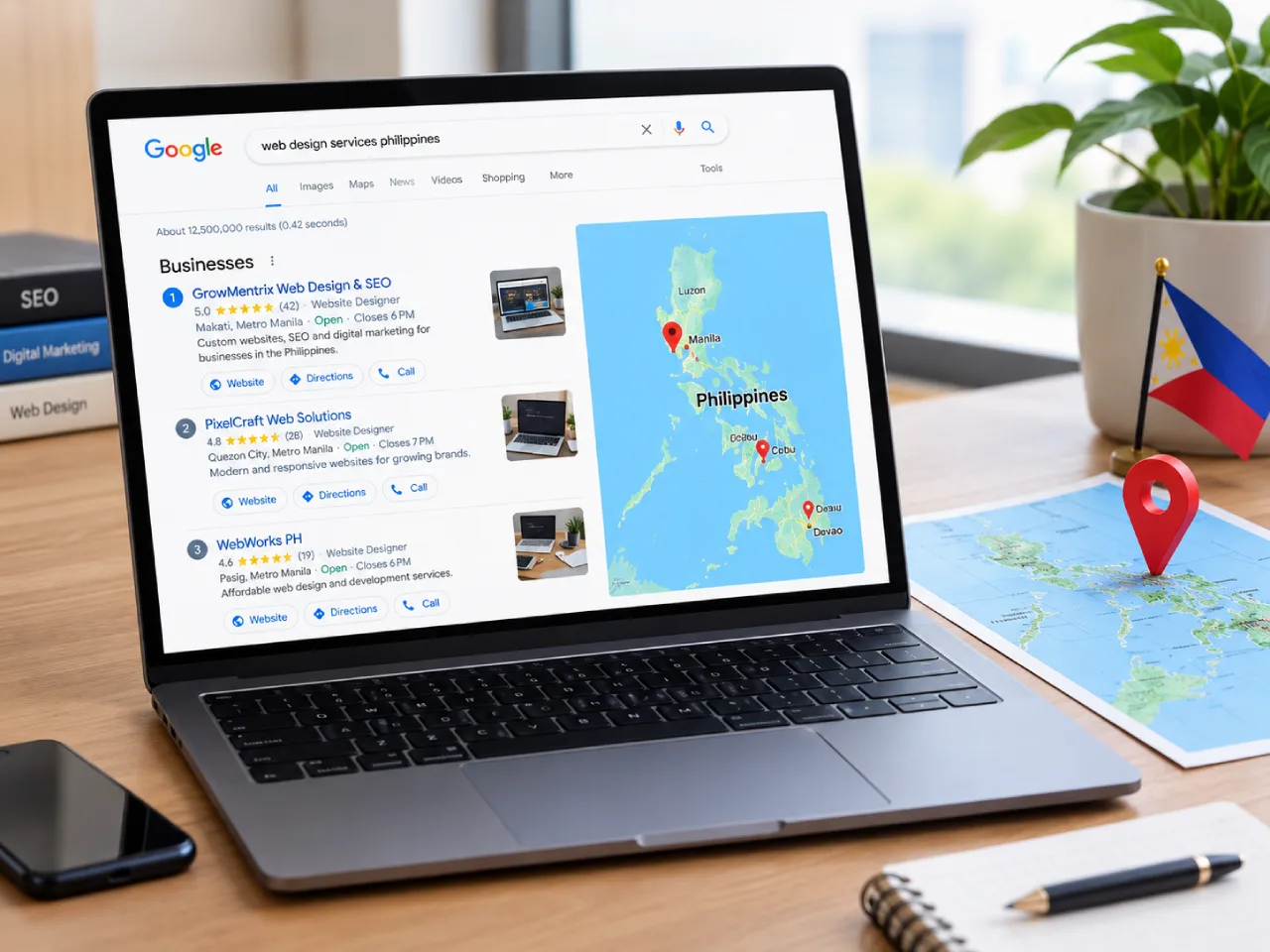
It starts with a Google Business Profile, the map listing that shows up when someone searches for your type of business in your area. A complete, accurate profile with real reviews is one of the strongest local signals Google reads. Then make sure your name, address, and phone number are identical everywhere they appear online. Inconsistency confuses Google, and confusion costs rankings. Finally, get your city and neighborhood into your content naturally, not just “we offer web design” but “web design services in Baguio City.”
The reason local SEO wins so fast is simple: the competition is thinner. It is far easier to be the best plumber in one city than the best plumber in the country, and Google knows that.
Why Does Trust Decide Rankings in the Long Run?
Content and technical SEO get you in the game. Trust decides who wins it. In SEO, trust mostly means links from other reputable sites pointing to yours, plus time and consistency.
You do not buy this part, and anyone selling “high authority backlinks” is usually selling garbage that will eventually hurt you. Trust is earned by being good for long enough that other people notice and reference you. Guest posts on real sites, directories that matter, press, and simply being worth linking to. It is the slowest factor and the hardest to fake, which is exactly why it carries so much weight.
How Long Does It Actually Take?
Here is the honest timeline most SEO advice hides: three to six months to see real movement, and six to twelve months to build meaningful rankings in a competitive niche. Local, low-competition terms can move faster, sometimes weeks, but the general rule holds.
If someone promises page one next week, run. What they are selling is either a lie, a black-hat trick that will get your site penalized, or a term so worthless it does not matter. Real SEO is a compounding investment, not a purchase. The businesses that win are the ones that start early, stay consistent, and let the work accumulate.
If your site is already live but stuck, my guide to why your website is not ranking walks through the most common reasons one by one.
What Are the Most Common SEO Mistakes in the Philippines?
The most common SEO mistakes in the Philippines are not technical. They are targeting the wrong keyword with the wrong page, publishing content that does not fully answer the search, and ignoring the local signals, like a Google Business Profile, that decide most Philippine rankings. A site can be fast, clean, and well designed and still make all three of these mistakes.
The fix is usually to check what Google is already ranking for each keyword, make the right page the best answer, and fill in the missing questions instead of adding more pages. Most stuck sites do not need more content. They need the right page targeting the right keyword with the right local signals.
What Do Organic Search Engine Optimization Services Actually Do?
Organic search engine optimization services are the ongoing work of making your site rank without paying for ads: fixing technical issues, building content around the right keywords, earning links, and reporting on results. They cover the whole process this guide describes, done consistently over months so the rankings compound.
For most business owners, the honest split is this: you can do the fundamentals yourself, and the technical, time-heavy execution is where help pays for itself. If you want the technical foundation and the long, consistent work handled for you, that is exactly what my on-page and technical SEO service covers.